
Camp Davies is definitely not your kids’ summer camp. Head to Calistoga, CA for wine camp at Schramsberg Vineyard. This wine camp for adults is a must!
As a foodie, wine enthusiast, writer, and photographer, I am often invited to unique, educational, and fun events. While working on a story at Schramsberg Vineyard in Calistoga, California, Matt Levy, Schramsberg’s marketing and e-commerce manager, invited me to Camp Davies. The following month I attended the wine camp and expanded my knowledge of how particular wine elements interact with various food flavors.
Schramsberg and Davies Vineyards are both located in Napa Valley. This region is renowned for its stunning vineyards and incredible wines. Charles Krug, the first official winery in Napa Valley, began planting grapes in 1861. German immigrant Jacob Schram soon followed his efforts. Jacob planted his first grapes in 1862, making Schramsberg Vineyards the second oldest winery in the Napa Valley.

Jacob Schram and his wife, Annie. Photo courtesy of Schramsberg Vineyards
The Beginning of Schramsberg Vineyards
Jacob Schram was born in Pfeddersheim, Germany, in 1826, and in 1842 he left Germany and took a ship to the United States, where he studied to become a barber. Jacob met Annie, his bride, in New York, and they traveled to California in 1849. Here he set up shop on what is now Montgomery Street in the financial district of San Francisco. The Gold Rush began in January 1848, and San Francisco grew from a small settlement of about 200 residents in 1846 to a city of about 36,000 by 1852.
As time went by, many affluent men sat in Jacob’s chair. These were not prospectors but businessmen who thrived in the growing city. They owned hotels, stores, saloons, and other profitable yet less respectable establishments. These men would chat with Jacob about financial opportunities while getting their hair cut or getting a shave. Jacob soon parlayed his money, and during his travels to Napa Valley, he fell in love with the area and purchased 400 acres in Calistoga.
The First Hillside Vineyards
Where Jacob grew up in Germany, grapes grew on steep, terraced hills. He knew that stressed vines produce exceptional grapes. Jacob established his vineyards on the hillside known as Diamond Mountain. Over the years, he soon had more than 30,000 vines.

These beautiful grapes are ready to pick. Photo by Tracy Ellen Beard
The First Caves in Napa Valley
Jacob understood that wine was often lost during Napa Valley’s hot summers. Between 1863 and 1869, approximately 15,000 Chinese workers helped build the transcontinental railroad. After its completion, Jacob hired a team of Chinese workers to build a cave structure on the vineyard property where he could store and age his wine.
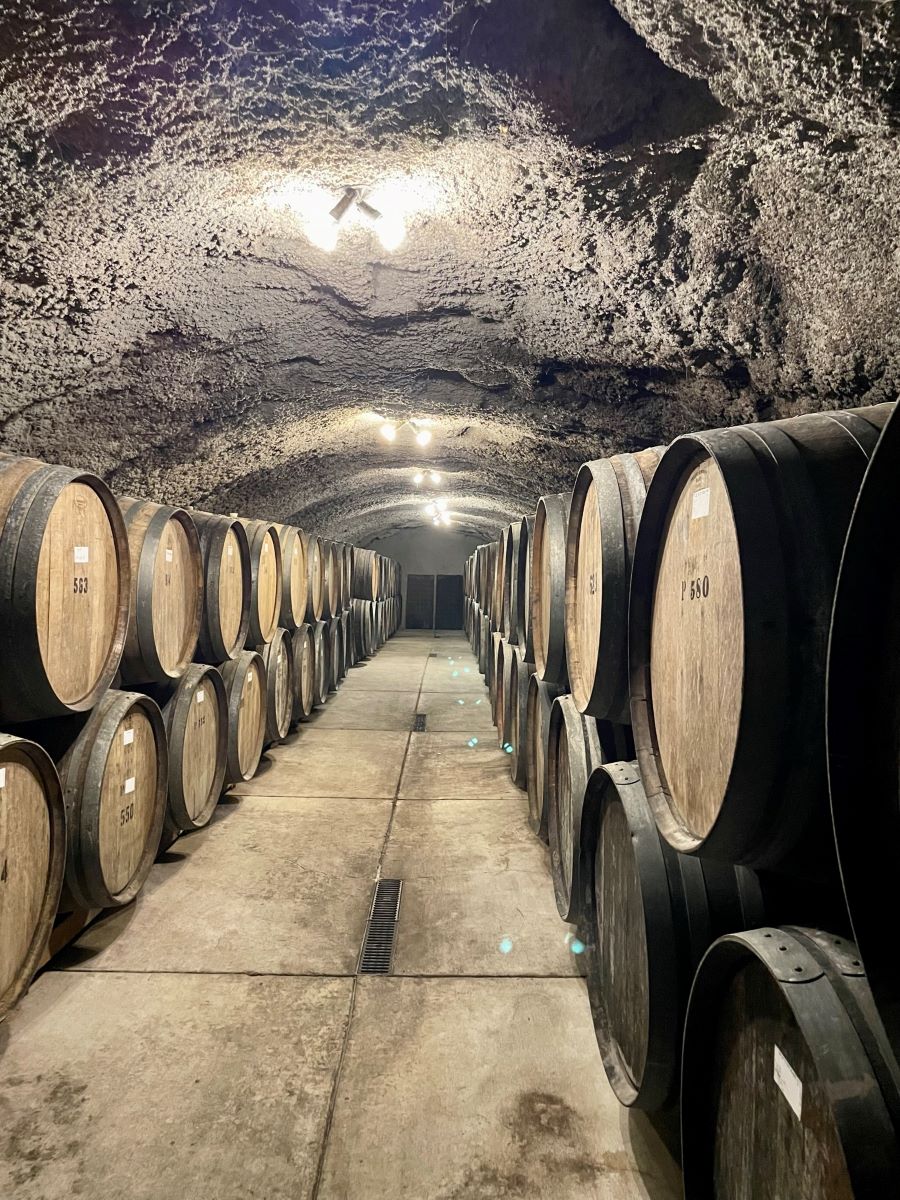
Schramsberg Vineyard caves. Photo courtesy of Schramsberg Vineyards
The Rebirth of Schramsberg Vineyards and a New Label
The winery did well producing delicious sparkling wines, but after many years the business fell into disrepair. However, in 1965, Jack and Jamie Davies purchased Schramsberg Vineyards and brought sparkling wine production back to life. The couple also began making cabernet sauvignon and pinot noirs under the Davies Vineyards label. Today, Hugh Davies, son of Jack and Jamie, is the owner of both Schramsberg Vineyards and Davies Vineyards.

Owner Hugh Davies speaks at wine camp. Photo by Tracy Ellen Beard
Matt has run a wine camp twice a year for the past 25 years. The next Camp Davies is March 2023. Camp Schramsberg will be open in the fall of 2023 and the spring of 2024. Camp Davies and Schramsberg are both two-and-a-half-day food and wine extravaganzas for enthusiastic wine consumers, members of the trade, restaurant owners, and sommeliers. During my days at camp, I learned about viticultural and winemaking practices, professional tasting, evaluation techniques, and how to pair great food with fabulous wines. Many camp activities occur in the vineyards, and others happen in a classroom setting.
Opening Night at Wine Camp
Camp Davies opened with a welcome dinner in the J. Davies Estate Diamond Mountain Vineyards, and Hugh Davies welcomed the campers and introduced the staff and Chef John Vega from Brasswood. Chef Vega prepared all the meals and test trays for the campers over the following two days.

Welcome dinner at Camp Davies. Photo by Tracy Ellen Beard
My camp experience began on a gorgeous night in the vineyard, and the food and wine pairings were exceptional. Campers mingled while sipping Schramsberg bubbles and then sat at long tables enjoying specially selected bottles of Davies wines paired with herb-infused pappardelle and short rib sugo, herb-crusted lamb loin, and cheesecake bites. It was a fun-filled evening and a fabulous way to launch the Fall 2022 Camp Davies.
In the Vineyard
The following day we all loaded onto a bus and headed to the vineyard to learn about the vineyard operations and the winemaking process. During the fall camp, we learned how to pick fruit; in the spring, attendees learn how to prune the vines.

Harvesting the grapes during wine camp. Photo by Tracy Ellen Beard
The Winemaking Process
After picking the grapes, they go through a destemming process and are transferred into T-bins or tanks. The T-bins are placed in a cold room overnight, or the tank temperature is set to 50 degrees to cold soak the grapes for one to two days.

The fruit of my labor. Photo by wine camp attendee
Next, the grapes receive yeast inoculation and go through cap management. Sometimes a punch-down tool is used to break the cap.

Trying out the punch-down technique at wine camp. Photo by Tracy Ellen Beard
Another option is to use the pump-over method that draws juice from the bottom of the bin and gives the cap a gentle shower.

Learning the pour-over technique to break the cap. Photo by Tracy Ellen Beard
The free-run or first juice is drained from the tanks and bins and stored in barrels. Then the grapes are put into a basket and gently pressed to extract the remaining liquid.

The free-runoff is gone, and the remainder of the grapes go into the basket for pressing. Photo by Tracy Ellen Beard
The wine is put into different barrels to create the preferred flavor. Malolactic fermentation reduces acidity and increases the wine’s stability by converting malic acid to lactic acid, producing a broader, rounder, palate-filling wine.

Barrels at Davies Winery. Photo by Tracy Ellen Beard
In the Classroom at Wine Camp
Wine pairing can be easy or overwhelming. The old philosophy is that fish and light meats go with white wines and red meats and strong sauces go with red wines. Although this works fine in lots of situations, many of today’s home cooks are experimenting with more complex dishes.
The camp classes were at Brasswood Cellars. Chef Holly Peterson, the camp food-pairing instructor, has worked worldwide in every aspect of the food and wine industry, including teaching at the Culinary Institute of America in California. During camp, we spent hours tasting food and wine combinations that ran the gamut from excellent to horrid, and then we discussed why some pairings worked, and others did not.

Classroom at Brasswood. Photo by Tracy Ellen Beard
We discussed the cause and effect of food with wine, which helped us better understand how the flavor of the wine changes depending on the food we eat. Acid, sugar, fat, and tannins all come into play. We learned to ask: Why does this wine taste different with this or that food? Does this wine contrast or complement the flavors in the food? How does a particular wine play across the board when planning a menu?
We learned how herbs, spices, sauces, flavorings, and cooking techniques change how wine interacts with the main ingredient in the dish. For instance, consider the average chicken breast—poached, broiled, or roasted—and you can pair it with almost anything. If you use a blackening method or top it with sweet chili sauce, carefully consider your wine choices.

Herb tasting at wine camp. Photo by Tracy Ellen Beard
Helpful Hints from Wine Camp
- Taste your wines before serving them. Make any flavor adjustments before serving the meal.
- Try to complement or contrast your food and wine. Example: The potage below features one prominent yet subtle spice—anise. Find a wine that showcases the same spice or complements it.

Potage. Photo by Tracy Ellen Beard
- Rethink using processed salt that can make certain wines taste metallic. Use kosher or sea salts.
- If you choose a wine with a spicy element, it will make spicy foods hotter. Add cream or butter to the dish to counteract or mellow the reaction. The other option is to serve spicy food with sweeter wines. Example: Serve spicy Thai food with a sweet Riesling or a Gewürztraminer.

Pork belly with a sweet sauce at the library dinner. Photo by Tracy Ellen Beard
- A super-sweet wine will make sweet foods taste less sweet. Consider pairing sweet foods with a wine exhibiting more tannins or acidity and less sugar. Other options include serving sweet dishes with dry bubbles or a tawny port that is sweet but not cloying.

A delicious sweet chocolate tart served at a camp dinner. Photo by Tracy Ellen Beard
- Know that soy and umami flavors go well with earthy wines.
- Adding mushrooms or truffles to a dish makes it scream for a pinot noir pairing.
- Combining bitter and bitter makes overwhelming bitter. Beware of those bitter notes found in some cabernets. You do not want to serve them with something bitter like radicchio. Olive oil is also something that can have noticeably bitter notes. Be cautious when using potent extra virgin olive oils.

Items to taste during wine camp. Photo by Tracy Ellen Beard
Articles Related to Camp Davies – Wine Camp for Grown-ups
- Wine Chat with Wine Expert Leslie Sbrocco
- Discover Incredible Wines at Sonoma County’s Dry Creek Wineries
- Coeur d’Alene Boasts Wines From Top-Notch Idaho Wineries
- Celebrate Syrah—Walla Walla Valley Wine
- Drinking with Intention
- Santa Ynez Wineries: Experience Wine from Gleason Family Vineyards
Wine Camp for Grownups
Camp Davies and Schramsberg originated more than 25 years ago when winning chefs came out to the vineyards for a weekend. Later, this camp became a more educational experience for wine aficionados, tradespeople, and sommeliers. Fred summed up today’s Camp Davies when he said, “Now it’s just a great excuse to get into food and wine for two days.” Whether you attend Davies Wine Camp in California, visit wineries in Washington, Oregon, or elsewhere, let Wander With Wonder be your guide.

.

0 Comments