
Discover Nepal’s cliff honey harvest in Bhujung, where Gurung hunters descend bamboo ladders. Learn when to visit, what homestays cost, and what to expect.
Nepal’s cliff honey harvest is an extraordinary tradition in the Gurung hills, where generations of honey hunters have climbed bamboo ladders to gather honey from towering rock faces.
I had been in Bhujung for three days by then, long enough to stop noticing the woodsmoke and learn which stone steps through the village were slick in the morning. But I was not ready for the puja at the base of the cliff, or for how quiet forty people can be when a man is about to climb down a rock face on a ladder made of bamboo and nettle rope.
Min Bahadur Gurung, who had been cutting comb on these cliffs for twenty-two years, crouched over the offering of rice and marigolds and asked the forest to allow it. Then he put his hands on the ladder.

Bhujung Village in Nepal. Photo by Barsha Kafle, Courtesy of Best Mad Honey
Journey to Bhujung in Nepal’s Gurung Hills
I live in Kathmandu, Nepal’s capital, and I’d heard about the honey cliffs for years without ever going. Everyone in the trekking business here has a version of the story, usually involving a documentary crew and a village that has grown tired of them.
What finally got me on a bus to Besisahar was a conversation with a friend from Lamjung who said the thing nobody films is the ladder. Not the cutting. The ladder. Four men spend the better part of a week building it from fresh bamboo and allo nettle fiber, and when it is finished they hang the whole of a man’s life on it.

Four men spend a week building a ladder from fresh bamboo and allo nettle fiber to harvest the honey. Photo by Barsha Kafle, Courtesy of Best Mad Honey
The ride from Kathmandu took a little over six hours to Besisahar, then a jeep to the roadhead at Hugdi. From there, the village is a two-hour climb on stone paving, past millet terraces and a water mill, with Lamjung Himal showing itself whenever the cloud thinned. I arrived sweating in October air and was handed tea before I had put my bag down.
Preparing for the Cliff Honey Harvest
Honey Harvest Day does not begin at the cliff. It begins the evening before, in the kitchen of the house where the hunting team eats together.
I sat on the floor with a plate of dhido and watched men argue about the weather in a dialect I could not follow. My host’s son translated the parts he thought I needed. The combs were ready. The wind was wrong. The wind might be right by morning. Someone’s cousin had seen bees moving low on the far cliff, which meant something I never fully understood.
What struck me was how little any of it resembled an event. Nobody was performing. These were men deciding whether to go to work.
How Gurung Honey Hunters Harvest Cliff Honey
In the morning, the village walked out together, perhaps an hour along the ridge, children included, until the last stretch, when they were sent back.
The work splits three ways, and watching it, I understood why no single person can be called the honey hunter.
At the base of the cliff, two men built the smoke fires from green leaves and damp grass. The smoke rises in a slow column and persuades the bees outward. On the ridge above, four more handled the ladder and the lines that raised and lowered the baskets. And somewhere between them, suspended, Min Bahadur worked the comb loose with a bamboo pole longer than he was tall.
He wore no harness. He had a cloth over his face and nothing else.
The first comb came up in a wicker basket on a rope, dark and heavy and running at the edges, and the woman next to me said something that made everyone laugh, and that was the moment the day stopped feeling solemn and started feeling like a harvest.

The wild honeycomb climbs to the underside of the cliffs. Photo by Barsha Kafle, Courtesy of Best Mad Honey
Why the Honey Harvest Matters to the Gurung Community
Here is what I did not expect. The honey is not the point, or not the whole point.
The cliffs belong to the village rather than to any family. Harvest rights pass through households, the yield is divided by custom, and a man’s standing in Bhujung has something to do with what he contributes on that day. It is one of the last things the village does entirely together.
That is under pressure. The young men are in Pokhara, in the Gulf, in Malaysia. Min Bahadur told me through my host’s son that perhaps only three men are left in the village who can cut properly, and that his own sons have no interest. He did not say it bitterly. He said it the way you mention weather.

The honey harvest is a cultural tradition in the Gurung Village, but its future is uncertain as things change for today’s next generation. Photo by Barsha Kafle, Courtesy of Best Mad Honey
Export has complicated the picture in ways I am still thinking about. The combs from these cliffs honey are known as mad honey, red honey, hallucination honey, and the buyers who come to the village directly leave more of the money in the hills than the middlemen in Kathmandu ever did. Several households in Bhujung have a cash income now because of it. Whether that keeps the tradition alive or quietly turns it into a product is a question I heard argued in that kitchen more than once, and I do not think the village has settled it either.
Health and Safety Warning: Mad honey may contain grayanotoxins, naturally occurring substances that can cause serious poisoning, even in small amounts. Symptoms may include dizziness, nausea, vomiting, dangerously low blood pressure, and an abnormally slow heart rate. Severe cases may require emergency medical treatment. Wander With Wonder does not recommend consuming mad honey for recreational or medicinal purposes. This article documents a cultural tradition and should not be interpreted as an endorsement of the product or its consumption.
Visiting Bhujung: Homestays, Guides, and Costs
I booked through the village homestay committee, which is how it works in Bhujung and in neighboring Ghalegaun and Pasgaun. Somebody in Pokhara knows somebody, and they make a phone call a few weeks ahead. Some sites can help you book, but visiting Bhujung still requires diligence.
I paid NPR (Nepalese Rupee) 2,000 a night (about $13), which covered a mattress on a wooden floor, a shared washing area, and three meals built around dhido, seasonal greens, and whatever chicken was available. A guide who spoke Gurung cost another NPR 3,000 a day (just under $20) and was the single best money I spent, because harvest-day access is a village decision, and that decision goes differently when the person asking is known.
Electricity came and went. Mobile data gave up above the village. I would not change any of it.
When to See Nepal’s Cliff Honey Harvest
The harvest happens twice a year: in spring, around April and May, when the rhododendron is heaviest, and again after the monsoon, in late October and November.
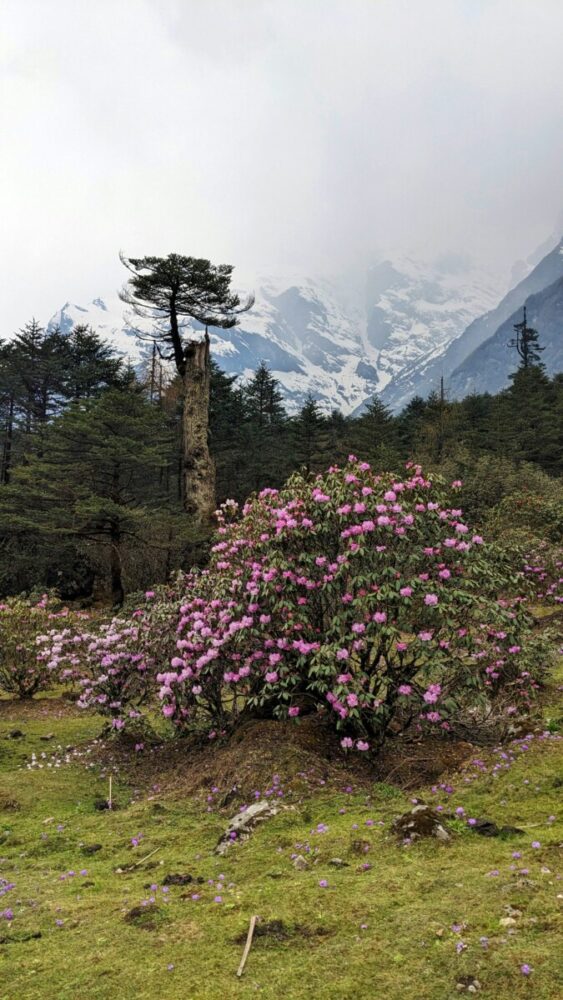
Spring is one of two seasons when they harvest honey and the rhododendron blooms during the spring season. Photo by Amit Merchant on Unsplash
That is as precise as anyone can be. Villages read the combs and the sky and decide within days. The harvest I saw was announced for one week and happened eleven days later, which meant I had time to walk to Ghalegaun and back and to spend an afternoon watching the ladder being rebuilt, which was the thing I had come for in the first place.
If you go hoping to tick a box on a fixed date, you will be disappointed. Go for the village and let the cliff happen if it happens.
What Visitors Should Know Before Going
- Stand where they tell you to stand. Comb and loose rock come off that face without warning. The smoke team needs clear ground, and nobody will have time to look after a guest who has wandered.
- Ask before photographing the puja. Some households consider it closed, and nobody will stop you, which is exactly why you should ask.
- Bring something useful. Tea, salt, or school supplies for the village school. Cash felt wrong in that kitchen, and I was glad I had brought other things. It’s best to ask the homestay committee what is appropriate. Hiring a local guide to help you through the process is best.
- Leave the children at home for the cliff day itself. Steep ground, open fires, and agitated bees are not a children’s afternoon, and the village will tell you so directly if you ask, as mine did.
What Remains After the Harvest
I came down to Hugdi two days later with a jar I had been given and no intention of opening, and a notebook mostly full of names.
What stays with me is not the comb or the drop. It is Min Bahadur standing on the ridge afterward, drinking tea, entirely unremarkable, while four men coiled a ladder that had held him over nothing at all.
More Articles About Cultural Travel Around the World
- How to Visit Hiroshima Respectfully: A Meaningful Guide
- Souvenirs Worth Buying During a Multi-Country Journey
- A Cultural Tour of Munich: Art, Fashion, History, and Beer Gardens
- Explore Chinatown in Vancouver and Learn to Make Dumplings
- An Evening with the Dublin Literary Pub Crawl
Discover More Extraordinary Cultural Adventures
Nepal’s cliff honey harvest reminds us that some of the world’s most memorable travel experiences aren’t attractions at all. They’re living traditions shaped by generations of knowledge, community, and connection to the land. Whether you’re drawn to the Himalayas or curious about cultures closer to home, explore more inspiring destinations and authentic travel experiences on Wander With Wonder. Let us help you discover the people, places, and traditions that make travel extraordinary.
.

0 Comments